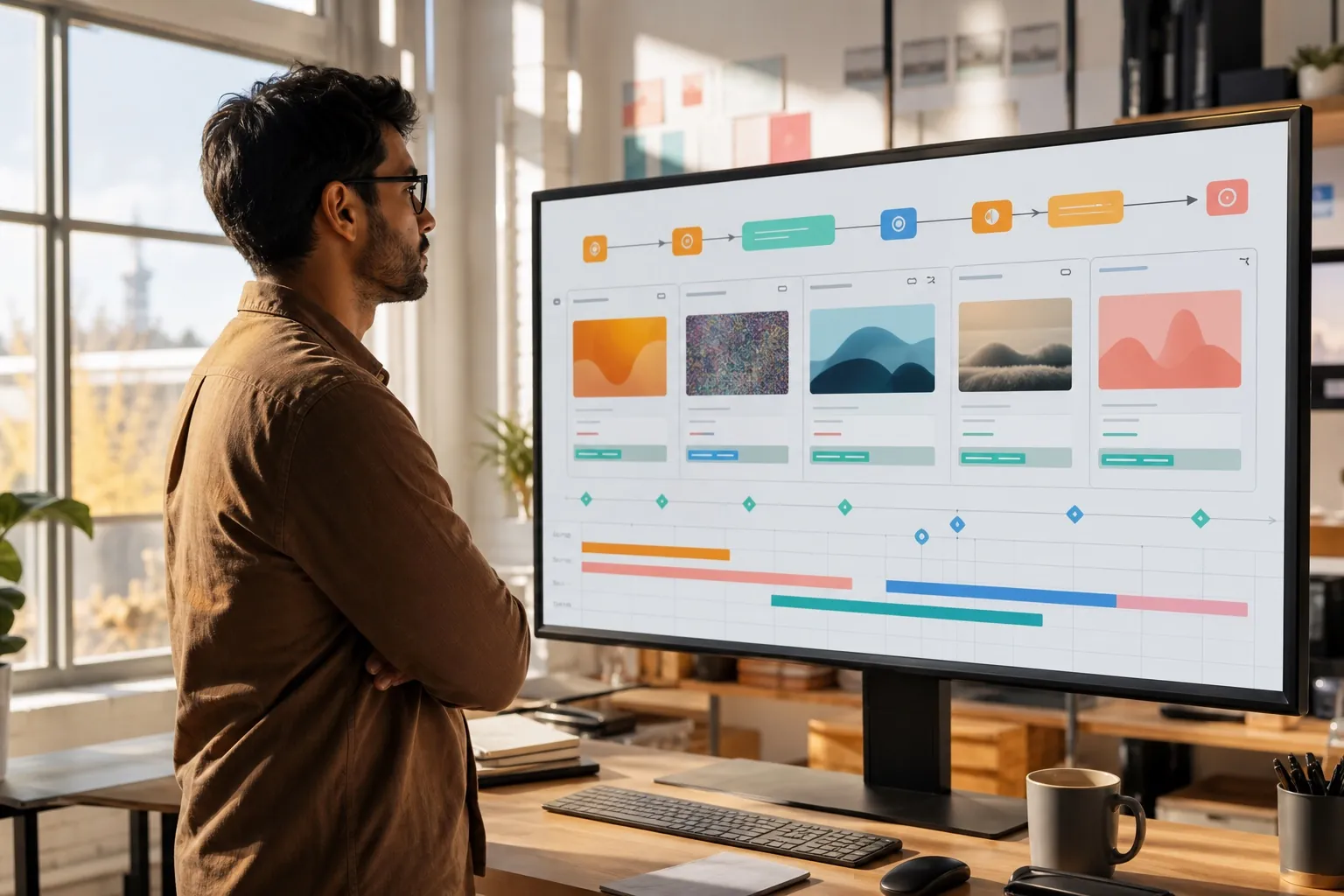

Claude Opus 5 arrives at a moment when AI products are moving from short conversations toward work that continues across codebases, tools and longer timelines. Anthropic positions the model around software engineering, research and sustained agentic tasks. That shift is important because a longer-running agent is not simply a faster chatbot; it is a new kind of product participant.
When an agent can plan, edit files, call tools and return hours later with a result, the interface has to explain much more than an answer. People need to understand the goal, the work in progress, the decisions already made and the point at which human judgment is required.
Progress becomes part of the interface
A spinner is enough for a two-second request. It is not enough for a task that may branch, recover from errors and update several systems. Long-running work needs a visible trail: current objective, completed steps, pending actions, blockers and artifacts. Good progress design reduces uncertainty without forcing people to inspect raw logs.
This also changes notification design. An agent should interrupt only when a decision materially changes the outcome, permission is required or risk increases. Everything else can become a concise checkpoint that a person can review when convenient.
Steering matters more than perfect prompting
The more capable an agent becomes, the less reasonable it is to expect one perfect instruction at the beginning. Products should make goals editable, assumptions visible and direction easy to revise. A user needs to be able to correct course without discarding useful work.
- Show the agent’s active goal and the latest meaningful result.
- Ask before irreversible or externally visible actions.
- Let people revise constraints without restarting the whole task.
- Separate verified facts from the agent’s assumptions.
- Make every generated artifact easy to inspect and compare.
Trust is an interaction pattern
Benchmark improvements matter, but trust is created in the product layer. Clear permissions, scoped actions, recoverable changes and honest uncertainty make a capable model useful in real work. The strongest agent experience will not feel autonomous for its own sake; it will feel like a well-designed collaboration.
Claude Opus 5 makes the direction visible. As models take on broader tasks, product teams need to design the operating system around them: intent, memory, checkpoints, approvals and handoff. That is where AI product design becomes more consequential than the prompt box.