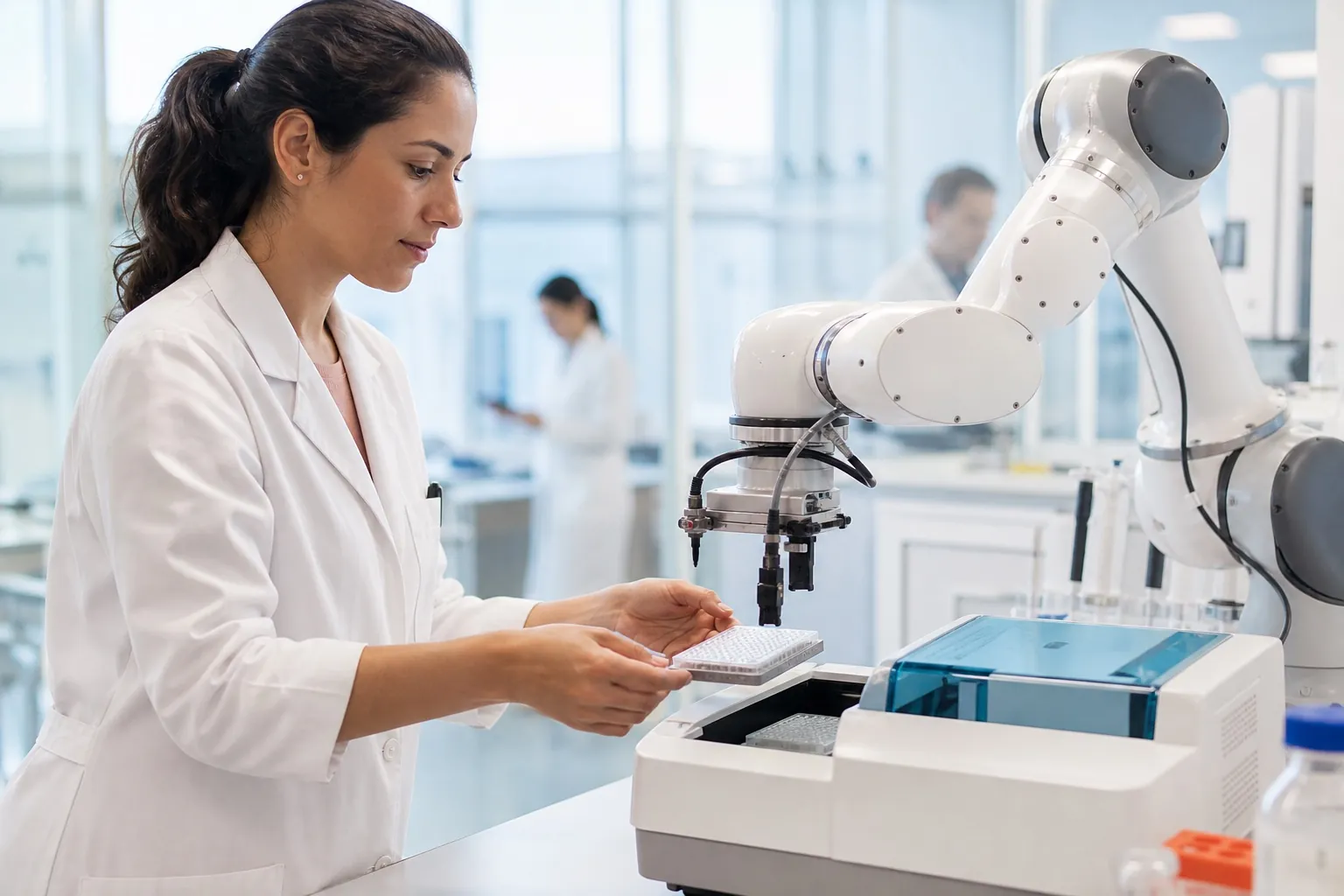

AI agents have mostly lived inside software: reading documents, calling APIs, writing code and moving information between tools. Anthropic’s Model Hardware Standard, announced as a research preview on 27 August 2026, pushes the same orchestration model into the physical world. It gives agents a common way to discover and operate programmable equipment, from microscopes and liquid handlers to robotic arms and quantum-computing hardware.
The technical ambition is interoperability, but the product implication is larger. Once an agent can affect a machine, every command carries physical state, timing, safety limits and real-world consequences. The interface is no longer only what a person sees on a screen. It includes the machine description, the allowed operations, the feedback loop and the moments when human approval is required.
A shared language for machines
Specialized equipment rarely arrives with a consistent modern interface. One device may expose an API, another may depend on a command-line tool, and an older instrument may only be controllable through desktop software. Anthropic describes MHS as a standardized driver layer that translates this variety into a small set of discoverable states and procedures.
The driver can describe what a device measures, what can be changed and which limits must be enforced. Natural-language tags add characteristics that code alone may not reveal, such as the weight of a robot arm or a safe operating range. An agent can then access the equipment through MCP, a command line or code, while the device keeps its normal underlying software.
The most useful physical-agent interface is not the one with the most controls. It is the one that makes capability, state and consequence impossible to confuse.
Why this is a design system for physical work
A conventional design system makes software components consistent. MHS points toward a similar system for machines: stable names, reusable commands, predictable states and shared safety rules. Designers and engineers will need to decide how a person understands that system while an agent is operating it. A status such as running is not enough if the user also needs to know which sample is active, what changed, what will happen next and whether the process can still be stopped.
- Show the agent’s current objective separately from the machine’s current state.
- Make safety limits visible before a command reaches physical equipment.
- Record who approved a consequential action and which parameters were used.
- Design interruption and recovery as first-class flows, not exceptional error screens.
- Translate machine telemetry into decisions a scientist or operator can verify quickly.
The early evidence is about orchestration
Anthropic’s preview describes laboratory demonstrations in which agents coordinated incompatible instruments through one manifest of states and procedures. In a Carnegie Mellon example, a system connected a liquid handler, plate reader, robotic arm and cameras spread across three computers. Six induced failure conditions—including a missing plate and an active emergency stop—were blocked before movement occurred.
The same experiment also shows why feedback design matters. After the first dilution run produced an unreliable curve, the agent rejected it, reduced the concentration range and repeated the experiment. The second result met the target without human intervention. That loop—observe, judge, adjust and verify—is the experience designers must make legible when autonomy leaves the screen.
Human approval needs more context, not more friction
Physical automation cannot rely on a generic confirmation dialog. A meaningful approval should explain the requested action, the affected device, the current machine state, the expected physical result and the safest way to interrupt it. Low-risk monitoring may run continuously, while changes involving heat, motion, pressure, biological materials or expensive samples should have stronger checkpoints.
This is where product design, operational safety and systems engineering meet. The agent needs room to explore, but the surrounding product must define a clear boundary between exploration and execution. Deterministic scripts can handle repeated low-level actions; the model can remain focused on planning, interpretation and exception handling.
What product teams should learn from MHS
Most teams will not connect an AI agent to a laboratory tomorrow. The transferable lesson is that capability descriptions are becoming part of the product surface. Whether the target is a robot arm, a finance workflow or a customer-support system, an agent performs better when it can discover bounded actions, read reliable state and understand constraints before acting.
MHS is still a research preview, and Anthropic says it is working with early partners on evaluations and best practices before an open-source release. That uncertainty is a reason to prototype carefully, not to ignore the direction. The teams that learn to design observable, interruptible and accountable agent workflows now will be better prepared when software begins operating more of the physical world. See how I design clear product systems